Methenolone Acetate 25mg (Primobolan) | NexorinPharma
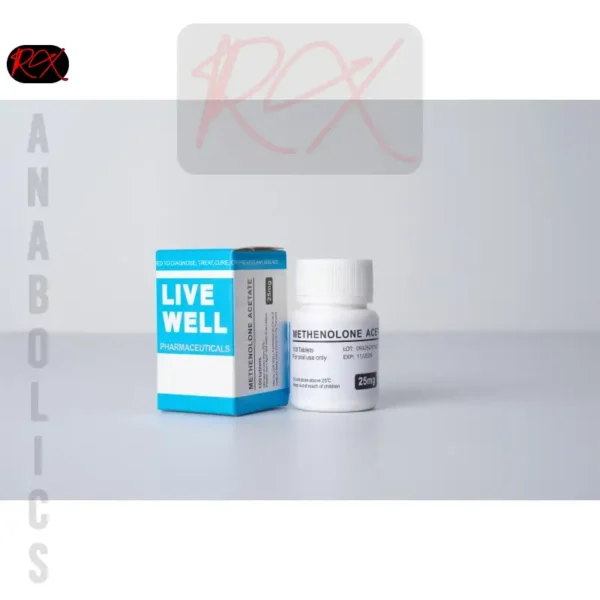
Methenolone Acetate 25mg is an oral anabolic steroid containing 25mg of Methenolone Acetate per tablet. At NexorinPharma, we carry Methenolone Acetate 25mg as part of our oral anabolic steroid inventory for customers in markets where Methenolone Acetate is legally available.
Methenolone Acetate is the active compound in this preparation, widely referenced in bodybuilding and performance communities under the brand name Primobolan. Unlike most oral anabolic steroids, Methenolone Acetate does not use 17-alpha alkylation to achieve oral bioavailability. This structural distinction consequently produces a significantly lower liver toxicity profile compared to most other oral anabolic steroids discussed in performance communities.
The 25mg per tablet concentration represents a lower per-tablet dose than the 50mg format available in non-prescription markets. This distinction is relevant context for anyone comparing Methenolone Acetate preparations across different concentration formats. This page covers what Methenolone Acetate is, how it works, and what health and legal considerations apply. It does not constitute medical advice, recommend steroid use, or provide dosage, cycle, or stacking guidance of any kind.
Product Specifications
| Specification | Details |
|---|---|
| Product Name | Methenolone Acetate 25mg |
| Active Compound | Methenolone Acetate |
| Also Known As | Primobolan, Primo, Oral Primobolan |
| Drug Class | Anabolic-androgenic steroid, DHT derivative, oral non-17-alpha alkylated steroid |
| Concentration | 25mg per tablet |
| Presentation | Oral tablet |
| Form | Tablet |
| Half-Life | Approximately 4 to 6 hours |
| Route of Administration | Oral |
| Anabolic Rating | 88 relative to testosterone baseline of 100 |
| Androgenic Rating | 44 to 57 relative to testosterone baseline of 100 |
| Aromatization | None |
| 17-Alpha Alkylated | No |
| Liver Toxicity | Low |
| Legal Status | Schedule III controlled substance in the United States. Prescription required. Legal status varies by country. |
| Availability | nexorinpharma.com |
What Is Methenolone Acetate
Methenolone is a synthetic anabolic-androgenic steroid derived from Dihydrotestosterone. Squibb introduced it to the market in the 1960s under the brand name Nibal in oral form and Nibal Depot in injectable form. Schering later acquired the rights and produced it under the Primobolan brand name, which consequently became the most widely recognized name for this compound in bodybuilding and performance communities globally.
Structurally, Methenolone is a DHT derivative with a double bond between carbon atoms 1 and 2 of the steroid structure. This modification increases its anabolic activity compared to base DHT. In addition, a methyl group at the first carbon position improves its resistance to metabolic breakdown. These structural characteristics produce a non-aromatizing anabolic steroid with a moderate anabolic profile and relatively low androgenic activity.
The acetate ester attached to the base Methenolone compound determines its release rate and oral bioavailability. Unlike most oral anabolic steroids, Methenolone Acetate achieves oral activity through the acetate ester rather than 17-alpha alkylation. This non-alkylated structure is directly responsible for its significantly lower liver toxicity profile compared to alkylated oral anabolic steroids. Consequently, Methenolone Acetate occupies a distinct pharmacological position among oral anabolic steroids as a non-17-alpha alkylated preparation.
About the 25mg Concentration
The 25mg per tablet concentration of Methenolone Acetate represents the lower end of standard non-prescription oral Primobolan tablet formats. Understanding this context is relevant for anyone comparing this product to the 50mg format and historical clinical tablet formats.
Comparison With Historical Clinical Formats
Historical pharmaceutical grade oral Primobolan was available at 5mg and 25mg tablet formats in various markets. The 25mg concentration consequently aligns directly with the upper end of the historical pharmaceutical clinical tablet format for oral Methenolone Acetate. This alignment with established clinical dosing is a relevant consideration compared to higher-concentration non-prescription formats.
Comparison With 50mg Format
The 50mg non-prescription format delivers double the active compound per tablet compared to this 25mg preparation. As a result, the 25mg format provides more conservative per-tablet dosing and more precise dose management than the 50mg format. The pharmacological profile of the active compound is identical between both formats.
First-Pass Metabolism Context
Oral Methenolone Acetate undergoes significant first-pass liver metabolism due to its non-alkylated structure. Higher oral doses consequently compensate for this metabolism to achieve meaningful plasma concentrations. The 25mg format consequently requires higher tablet counts to achieve plasma concentrations comparable to the injectable Methenolone Enanthate form. This is an inherent characteristic of non-alkylated oral Methenolone preparations at any concentration.
Non-Prescription Market Context
Methenolone Acetate 25mg is produced for markets where Methenolone Acetate is legally available outside of prescription channels. It does not carry the manufacturing oversight, regulatory scrutiny, or clinical documentation of pharmaceutical grade prescription products. Quality, purity, and concentration accuracy are consequently less verifiable than with regulated products.
How Methenolone Acetate Works
Methenolone Acetate is active when taken orally. The acetate ester improves its oral bioavailability compared to unmodified Methenolone. However, its non-alkylated structure means it undergoes more significant first-pass liver metabolism than 17-alpha alkylated oral steroids. As a result, oral Methenolone Acetate requires higher doses than the injectable Methenolone Enanthate form to achieve comparable plasma concentrations.
Androgen Receptor Binding
Methenolone Acetate binds to androgen receptors throughout the body. Its anabolic rating of 88 and androgenic rating of 44 to 57 relative to testosterone reflect its moderate receptor binding activity. As a result, androgen receptor activation in muscle tissue drives its anabolic effects while producing comparatively lower androgenic activity than testosterone-based compounds.
Nitrogen Retention
Methenolone Acetate produces positive nitrogen retention in muscle tissue. The body retains more nitrogen than it excretes. Consequently, this supports an anabolic environment that favors muscle repair and preservation. This mechanism is particularly relevant in contexts where lean muscle tissue maintenance is a primary consideration.
Protein Synthesis
Methenolone Acetate accelerates protein synthesis in skeletal muscle tissue. Faster protein synthesis supports muscle repair and maintenance. This mechanism is directly tied to its androgen receptor activity and consequently contributes to the lean mass preservation observations consistently reported in performance community discussions about Methenolone use.
No Aromatization
Methenolone Acetate does not convert to estrogen through the aromatase enzyme pathway. As a DHT derivative, it is not a substrate for aromatase. Consequently, estrogen-related side effects including water retention and gynecomastia are not part of its direct pharmacological profile. This characteristic is one of the most consistently referenced pharmacological distinctions of Methenolone in performance community discussions.
No Progestogenic Activity
Methenolone Acetate does not show clinically significant affinity for progesterone receptors, distinguishing it from compounds like Trenbolone and Nandrolone where progestogenic activity is a primary side effect consideration. As a result, Methenolone Acetate carries a cleaner overall hormonal side effect profile compared to progestogenic anabolic steroids.
IGF-1 Stimulation
Methenolone Acetate increases Insulin-like Growth Factor 1 production. IGF-1 plays a direct role in muscle repair, recovery, and anabolic activity throughout the body. This mechanism consequently contributes to the recovery-related observations consistently discussed in performance communities about Methenolone use.
Why the Non-17-Alpha Alkylated Structure Distinguishes Methenolone Acetate
The absence of 17-alpha alkylation in Methenolone Acetate is its most pharmacologically significant structural distinction from most other oral anabolic steroids. Most oral anabolic steroids including Methandrostenolone, Stanozolol, Oxymetholone, and Oxandrolone use 17-alpha alkylation to survive first-pass liver metabolism. This alkylation process is directly associated with hepatotoxicity.
Methenolone Acetate achieves oral activity through the acetate ester rather than alkylation. As a result, it places significantly less stress on liver tissue than alkylated oral anabolic steroids. This lower hepatotoxicity profile is the primary practical distinction that drives Methenolone Acetate’s discussion in performance communities as a relatively liver-friendly oral anabolic steroid option.
The trade-off for this lower liver toxicity is higher first-pass metabolism. More of the orally administered dose breaks down before reaching systemic circulation compared to alkylated alternatives. Consequently, higher oral doses are required to achieve plasma concentrations comparable to those produced by the injectable Methenolone Enanthate form.
Clinical Background
Methenolone carries a documented clinical history that provides relevant context for its pharmacological profile.
Muscle Wasting and Anemia
Methenolone was used clinically in several countries for the treatment of muscle wasting conditions and anemia. Its anabolic properties and relatively mild side effect profile made it a relevant clinical compound for these indications. This clinical history consequently provides a broader research base for understanding its pharmacological profile compared to compounds without any clinical application history.
Osteoporosis
Methenolone was also used clinically in some markets for the treatment of osteoporosis. Its anabolic effects on bone tissue and low androgenic activity relative to its anabolic potency made it a relevant compound for this indication.
Pediatric Applications
In some markets, Methenolone was used in pediatric contexts for growth promotion in children with growth deficiency conditions. This pediatric application reflects its documented low androgenic activity and relatively favorable safety profile compared to higher androgenic anabolic steroids.
Methenolone Acetate 25mg Versus Other Oral Anabolic Steroids
Versus Methenolone Acetate 50mg
Both preparations contain the same active compound with identical pharmacological profiles. The 25mg format provides more conservative per-tablet dosing and more precise dose management than the 50mg format. As a result, the 25mg format aligns more closely with historical pharmaceutical clinical tablet formats while the 50mg format delivers double the active compound per tablet.
Versus Methenolone Enanthate (Primobolan Depot)
Both preparations contain Methenolone as the active compound and carry identical anabolic and androgenic ratings. The oral acetate form has a shorter half-life of 4 to 6 hours and undergoes significant first-pass liver metabolism. The injectable enanthate form has a half-life of approximately 10 to 14 days, avoids first-pass metabolism entirely, and produces higher bioavailability per milligram. As a result, the injectable form is generally considered more efficient in terms of active compound delivered per milligram administered.
Versus Oxandrolone (Anavar) 10mg
Both Methenolone Acetate and Oxandrolone are oral anabolic steroids with relatively mild side effect profiles. However, Oxandrolone uses 17-alpha alkylation while Methenolone Acetate does not. As a result, Oxandrolone carries more liver stress than Methenolone Acetate despite being considered mild compared to other alkylated steroids. Methenolone Acetate 25mg consequently represents a lower hepatotoxicity oral anabolic option than Oxandrolone at any concentration.
Versus Stanozolol (Winstrol)
Stanozolol is a non-aromatizing oral anabolic steroid that uses 17-alpha alkylation. It carries more significant liver toxicity and more pronounced adverse lipid effects than Methenolone Acetate. In addition, Stanozolol’s androgenic activity and cardiovascular impact are more pronounced than Methenolone Acetate’s moderate profile. Methenolone Acetate 25mg consequently represents a milder profile than Stanozolol across liver and cardiovascular side effect parameters.
Versus Methandrostenolone (Dianabol)
Methandrostenolone aromatizes significantly to estrogen and carries significant liver toxicity from 17-alpha alkylation. Methenolone Acetate, by contrast, produces no estrogenic conversion and carries significantly lower liver stress. The pharmacological profiles of these two compounds are fundamentally different. Methenolone Acetate consequently represents a considerably milder pharmacological profile than Methandrostenolone across virtually all side effect parameters.
Side Effects and Health Risks
Methenolone Acetate 25mg carries a side effect profile that is generally considered milder than most oral anabolic steroids. These risks remain real and should not be minimized.
Liver Considerations
Methenolone Acetate does not carry the hepatotoxicity associated with 17-alpha alkylated oral anabolic steroids. Its non-alkylated structure produces a significantly lower liver stress profile than compounds like Methandrostenolone, Stanozolol, and Oxymetholone. However, this does not mean liver monitoring is unnecessary. Regular liver enzyme monitoring remains a responsible health practice for anyone using any oral anabolic steroid regardless of the specific hepatotoxicity profile.
Cardiovascular Effects
Methenolone Acetate produces adverse lipid profile changes. HDL cholesterol decreases while LDL cholesterol increases. These lipid changes carry long-term cardiovascular health implications. Regular lipid monitoring is therefore important for anyone using this compound despite its milder overall side effect profile.
Androgenic Effects
Despite its moderate androgenic rating, Methenolone Acetate still produces androgenic side effects in susceptible individuals. These include accelerated hair loss in genetically predisposed individuals and acne. In women, virilization effects including voice deepening and changes in body hair distribution are serious considerations even with milder androgenic compounds.
Hormonal Suppression
Methenolone Acetate suppresses the hypothalamic-pituitary-gonadal axis and the body’s natural testosterone production. The degree of suppression is generally considered less pronounced than with more potent anabolic steroids. However, post-use hormonal disruption remains a relevant consideration and in some cases results in hypogonadism requiring medical treatment.
Psychological Effects
Anabolic steroid use carries documented associations with mood changes and irritability. These considerations apply to Methenolone Acetate use and are generally less pronounced than with higher androgenic compounds. However, they remain relevant health considerations for anyone using this compound over extended periods.
Legal and Regulatory Status
Methenolone Acetate carries Schedule III controlled substance status in the United States under the Controlled Substances Act. Possession without a valid prescription is a federal offense.
In the United Kingdom, Methenolone Acetate falls under Class C of the Misuse of Drugs Act. Supply is illegal.
The World Anti-Doping Agency bans Methenolone Acetate alongside all major athletic governing bodies. As a result, it consequently appears on prohibited substance lists across Olympic sports, professional athletics, and competitive bodybuilding organizations that conduct testing.
You are responsible for confirming the legal status of Methenolone Acetate in your specific jurisdiction before purchasing from NexorinPharma.
Frequently Asked Questions
Is Methenolone Acetate 25mg Available at NexorinPharma
Yes. NexorinPharma carries Methenolone Acetate 25mg for customers in markets where Methenolone Acetate is legally available. Visit nexorinpharma.com to check current availability and pricing.
What Is the Half-Life of Methenolone Acetate
Methenolone Acetate produces a half-life of approximately 4 to 6 hours. As a result, regular daily administration is required to maintain stable plasma concentrations. This short half-life distinguishes it from the injectable Methenolone Enanthate form which produces a half-life of approximately 10 to 14 days.
How Does the 25mg Format Compare to the 50mg Format
Both preparations contain the same active Methenolone Acetate compound with identical pharmacological profiles. The 25mg format provides more conservative per-tablet dosing than the 50mg format and aligns with the upper end of historical pharmaceutical clinical tablet formats for oral Primobolan. The 50mg format consequently delivers double the active compound per tablet.
Does Methenolone Acetate Aromatize
No. Methenolone Acetate does not convert to estrogen through the aromatase enzyme pathway. As a DHT derivative, it is not a substrate for aromatase. Consequently, estrogen-related side effects are not part of its direct pharmacological profile.
Is Methenolone Acetate Safer Than Other Oral Anabolic Steroids
Methenolone Acetate carries a lower hepatotoxicity profile than most oral anabolic steroids due to its non-17-alpha alkylated structure. However, it still carries cardiovascular, hormonal, androgenic, and psychological health risks that require medical supervision to manage responsibly. Lower liver toxicity does not mean absence of health risks across all parameters.
What Are the Most Serious Health Risks
Cardiovascular effects from lipid dysregulation and hormonal suppression are the most clinically significant concerns. In addition, androgenic effects, psychological impacts, and liver enzyme considerations despite low hepatotoxicity complete the primary risk profile. Medical supervision and regular blood work monitoring are therefore essential for anyone using this compound.
Is Methenolone Acetate 25mg Legal to Purchase
Methenolone Acetate carries Schedule III controlled substance status in the United States and requires a valid prescription. Legal status varies by jurisdiction. You are consequently responsible for confirming the legal status in your jurisdiction before purchasing from NexorinPharma.
What to Consider Before Purchasing Methenolone Acetate 25mg
Methenolone Acetate has a documented clinical history across several markets and a well-established presence in bodybuilding and performance community discussions. Its non-aromatizing profile, low androgenic activity, non-17-alpha alkylated structure, and relatively mild side effect profile compared to most oral anabolic steroids contribute to its consistent discussion in performance communities.
The 25mg concentration aligns with the upper end of historical pharmaceutical clinical tablet formats for oral Primobolan, providing the most conservative non-prescription Methenolone Acetate format available. This alignment with established clinical dosing is consequently a relevant consideration compared to the 50mg format. Non-prescription preparations furthermore do not carry the manufacturing oversight of pharmaceutical grade products.
Methenolone Acetate carries documented cardiovascular, hormonal, androgenic, and psychological health risks. These risks require medical supervision to manage responsibly. Consulting a licensed medical professional is consequently the appropriate starting point for anyone with health concerns related to anabolic steroid use.
For customers in markets where Methenolone Acetate is legally available, visit nexorinpharma.com to check current Methenolone Acetate 25mg availability, pricing, and stock levels.
Be the first to review “Methenolone Acetate (Primobolan) 25mg”
Related products
Tablets
Tablets
Tablets
Tablets
Tablets
Tablets
Reviews
There are no reviews yet.